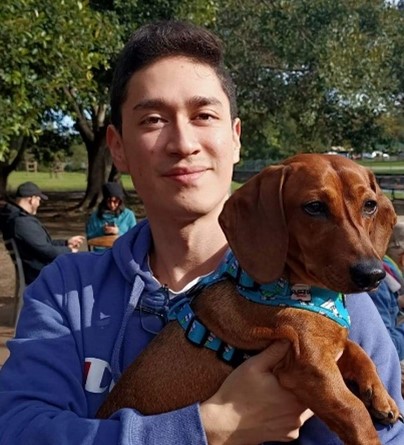
Fernando Tinoco
Fernando Tinoco received his Bachelor of Medical Science (Honours) from the University of Sydney and is now a late-stage PhD student. He currently works as a casual academic within anatomy and neuroscience, as well as a science communicator within biology and physics. His current research focuses on investigating a somatotopic map of the human periaqueductal grey during pain and analgesic processing utilising ultra-high field magnetic resonance imaging techniques.
Author contact details: fernando.tinoco@sydney.edu.au
Somatotopic representation of placebo analgesia in the human PAG
Another year, another memorable conference! The Australian Pain Society (APS) once again provides us the opportunity to uncover the latest advancements in pain research and explore a new city within Australia. The 2024 Annual Scientific Meeting (ASM) marks my third ASM and this year allowed me to travel to Darwin for the first time. I was particularly inspired by its rich history and cultural influence, diverse food scene, as well as the tropical harbour of the city. The ASM is always welcome and invites thriving academics, clinicians, and researchers in the pain sphere, making for insightful discussions and networking opportunities to be had.
This year, I was fortunate to present my work once again in a concurrent free paper session where I showed the results of one of my research papers from my PhD project. The aim of this investigation is to assess somatotopy (body-map representation) within the human periaqueductal grey (PAG) using a placebo analgesia paradigm. The PAG poses immense difficulty to study due to its small size (<5 mm) and location within the brainstem. Using a 7-tesla MRI, we can localise activity within the PAG to a higher degree of accuracy than that of a standard 3-tesla MRI would allow. Our results reveal that analgesia in the face and body displays a crude somatotopy within the PAG, with activity being rostral and caudal, respectively, that closely matches the pre-clinical literature. I would like to thank the attendees of this session and audience members who approached me after my talk to further discuss my findings, and to congratulate the other speakers for their fantastic presentations.
Every day of the ASM is filled with active plenary and topical sessions that are sure to pique the interest of all attending members. By the end of the final plenary talk, you are left with excitement about heading back to home with all these new ideas and knowledge that you can add to your work. A highlight for me was hearing from keynote speaker Professor James McCauley and his plenary talk on the movement towards psychologically informed management for lower back pain management really stood out to me. The content presented was relevant to my previous work on chronic neuropathic pain and has provided me with new insights on how to approach the psychophysics behind chronic pain management.
Likewise, the poster sessions offer us the chance to see the vast amount of multi-disciplinary research being done on pain, and to introduce ourselves to new faces. I had the privilege of meeting Yiru Guo, a Masters student who studied the effects and safety of a nerve cuff delivering an ionic direct current to the sciatic nerve in rodent models of neuropathic pain. This was a unique approach to pain management I haven’t seen before and has shifted my perspective on methods to treating and managing pain disorders. Particularly, the application of biomedical engineering in the field of neuroscience has greatly intrigued me and stimulated new ways of thinking around neuropathic pain.
It was once again a pleasure to attend the ASM in April and to share the experience with fellow colleagues, friends, and potential new collaborators. Hats off to the APS committee in hosting these brilliant conferences where we can all exchange knowledge and explore novel research from experts in the pain community. I would also like to thank the APS for their generous support in providing me with a travel grant to assist my expenses in attending this ASM and to expand on my professional network, particularly as I look for a post-doctoral role soon. Next year holds much to look forward to, in the grand city of Melbourne, and I hope to see you all there in 2025!
Declaration: Fernando Tinoco has nothing to declare.





 Australian Pain Society