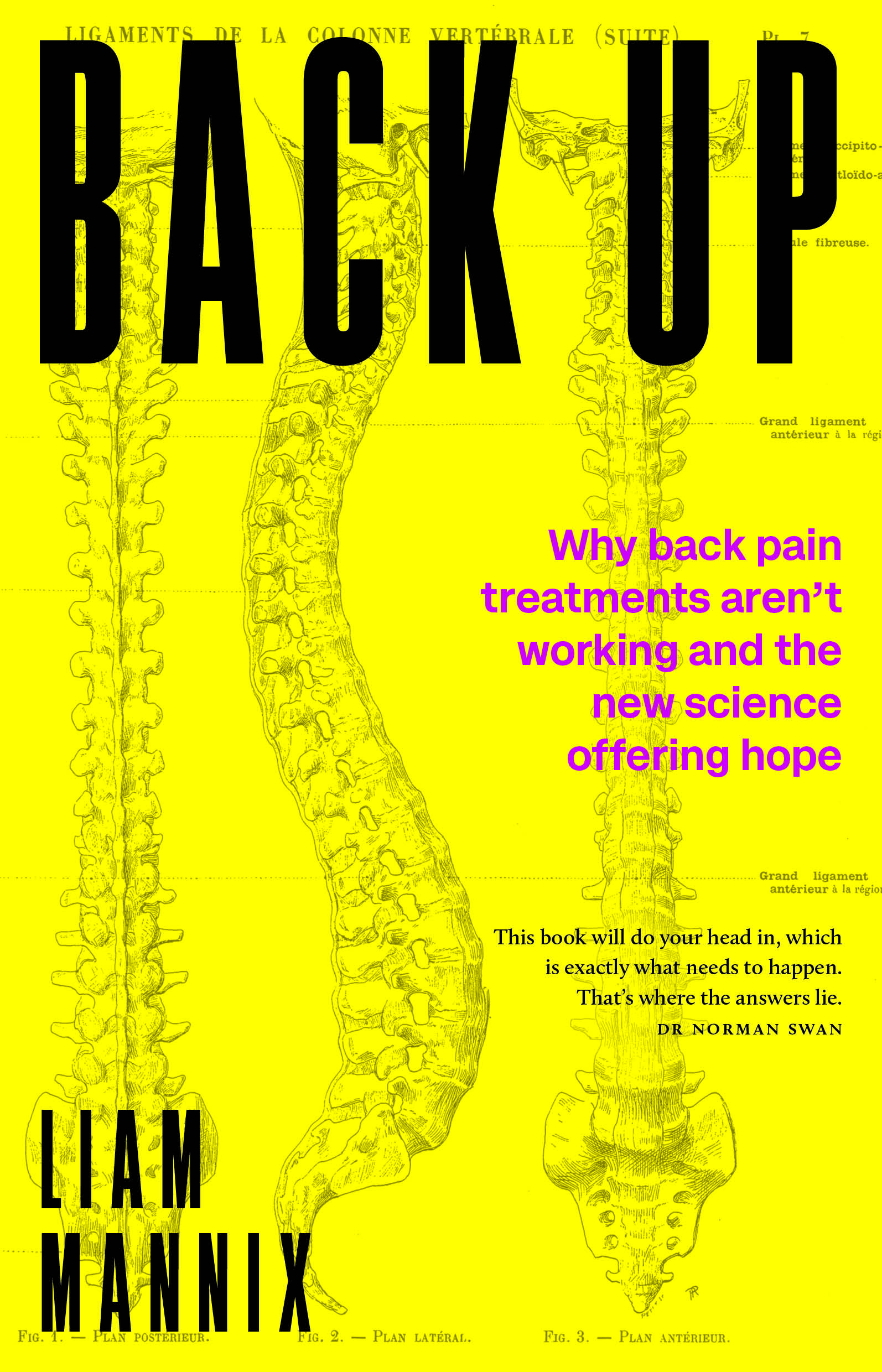
Author: Liam Mannix
Date published: August 2023
Publisher: NewSouth Publishing
ISBN: 9781742238081
Reviewer: Lincoln Tracy
Dr Lincoln Tracy is a researcher and writer based in Melbourne, Australia, and the editor of the Australian Pain Society eNewsletter.
Book Review
I was extremely excited to hear Liam Mannix talk about Back Up at the Annual Scientific Meeting in Canberra earlier this year. I was equally excited when my copy of the book arrived last month and when I sat down to read it.
Many members of the Society may be familiar with the broad range of experts Mannix speaks with and/or refers to – Tim Austin, Lorimer Moseley, Joshua Pate, Hayley Leake, James McAuley, Chris Maher, Tasha Stanton, Peter O’Sullivan, Mick Vagg – to name a few.
Many may be familiar with the history of (back) pain, and how treatments have evolved and become popular over time. How treatments like spinal fusions, nerve ablations, and opioids became (and remain) prominent, despite there being many questions about if and how they work.
And many will also be familiar with aspects of the “new science” underlying rehabilitation approaches for back pain, highlighted from a (potentially) unexpected source: the Australian Ballet Company.
In describing the approach implemented by the Company’s principal physiotherapist Sue Mayes – no scans (unless there is suspicion something has gone seriously wrong) and an intensive, personalised program of physical and psychological rehabilitation – Mannix describes how the effective management of back pain may be closer than we think.
A sense of familiarity with the history of back pain should not – and does not – detract from Back Up’s highly engaging mix of science and personal stories, including the shared experiences from Mannix, his father, and his friends about their own journeys with back pain.
The quote from Norman Swan, medical journalist and host of ABC Radio’s Health Report, seems highly appropriate for the level of impact Back Up could have on those outside of the pain world:
“This book will do your head in, which is exactly what needs to happen. That’s where the answers lie.”
One aspect of Back Up that has resonated with me is its focus on those who treat people with back pain and the challenges they face in providing safe, effective, and accessible evidence-based treatment. It is easy to denounce surgery as a ‘cure’ for back pain, but that doesn’t mean it still can’t have some benefit.
Mannix takes a balanced approach to this complex area, pairing clinical experiences from Ashish Diwan, a spinal surgeon, (where patients are grateful for the surgery despite not necessarily getting better) with the views of Ian Harris, an orthopaedic surgeon (who feels most, if not all, of the benefits of spinal fusion can be attributed to placebo).
The key messages of the book are beautifully summarised by Mannix in the conclusion:
“If we accept the evidence that back pain may be being driven in part by belief, by the way we think about and frame pain in our backs – well, part of the solution is going to be social. Changing the way we think about our backs. Changing the way we talk about them. Not freaking out when pain rears its head. When a colleague comes in with a sore back, treating it as an annoyance rather than a major problem. Seeking solutions that treat our bodies as complex, living, growing organisms that require a little stress, a little load for peak health – not as machines with readily replaceable parts.”
“Change the conversation, and we might be able to change back pain.”
Declaration
Lincoln Tracy has nothing to declare.





 Australian Pain Society
“If we accept the evidence that back pain may be being driven in part by belief, by the way we think about and frame pain in our backs – well, part of the solution is going to be social. Changing the way we think about our backs. Changing the way we talk about them.”
Where is the evidence that back pain may be driven (in part) by belief?
In the absence of evidence, the argument’s premise is pure speculation and the so-called solution is potentially damaging to the credibility of many pain sufferers.